
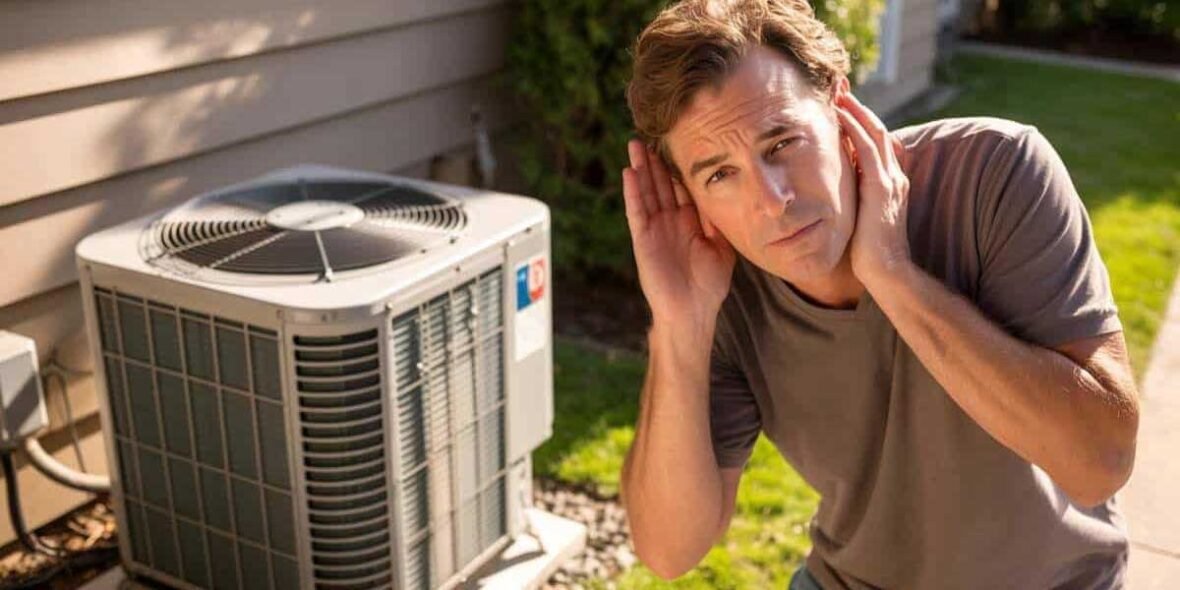
A loud buzzing AC unit usually points to an electrical part, a struggling motor, a loose panel, a failing contactor, or a compressor that cannot start normally.
Turn the system off if the buzz is harsh, new, paired with a burning smell, or coming from the outdoor condenser while the fan is not spinning. A soft hum during normal operation can be harmless. A loud electrical buzz is different.
Persistent mechanical vibrations often lead to subtle shifts in the alignment of internal components, which may eventually manifest as an irritating buzz. While a simple loose screw can sometimes be the culprit, more complex issues like failing contactors or worn isolation feet typically require a more thorough diagnostic approach to prevent permanent system damage. Experts like Dulin Mechanical Services Inc. emphasize that identifying the specific frequency and location of the sound is the first step toward a lasting resolution. Addressing these minor auditory warnings early not only preserves the compressor’s health but also ensures the system remains energy efficient during peak summer demand.
Quick Answer: When To Shut It Off
Shut the AC off at the thermostat, and use the outdoor disconnect if the condenser is buzzing but not running, the breaker trips, or you smell hot plastic.
That kind of buzzing can mean the compressor, fan motor, capacitor, relay, or contactor is being energized without starting correctly. Letting it keep trying can turn a repairable part into a much more expensive failure.
| What you hear or notice | Most likely area | How urgent it is | What to do now |
|---|---|---|---|
| Outdoor unit buzzes, fan does not spin | Capacitor, fan motor, compressor, or contactor | High | Turn cooling off and call an HVAC technician |
| Buzzing plus burning smell | Electrical wiring, motor windings, or overheated contact | Emergency | Shut it down and do not restart it |
| Buzzing stops when a panel is pressed | Loose cabinet, grille, or vibration point | Low to medium | Turn power off before tightening accessible screws |
| Indoor buzzing near the air handler | Blower motor, transformer, relay, or loose duct panel | Medium | Check filter and airflow, then schedule service if it continues |
| Buzzing after a storm or power flicker | Electrical controls or start components | Medium to high | Leave it off for a few minutes, then call if the buzz returns |
The simple rule is this: a vibration buzz can be investigated calmly, but an electrical buzz deserves respect. You do not need to diagnose the exact part before protecting the equipment.
The Most Common Causes Of AC Buzzing
Most AC buzzing comes from electrical resistance, a motor failing to start, refrigerant-related strain, or a loose cabinet part vibrating while the cooling system runs under load.
The noise can travel through metal panels and refrigerant lines, so the loudest spot is not always the failing component. Stand back, listen for the location, and avoid touching internal electrical parts.
Bad capacitor
A capacitor helps the compressor and fan motor start and run. When it weakens, the motor may hum or buzz instead of starting cleanly.
This is one of the classic causes when the outdoor unit buzzes but the fan blade sits still. Do not try to test or replace a capacitor unless you are trained, because it can hold a charge after power is off.
Failing contactor or relay
The contactor is an electrical switch that sends power to the outdoor unit. If its contacts are pitted, stuck, or chattering, the result can sound like a loud electrical buzz.
Sometimes the noise is brief at startup. Sometimes it continues until the thermostat stops calling for cooling, which is a sign to stop running the system.
Compressor trouble
The compressor is the most expensive component in many central air systems, and a loud buzz from the outdoor unit can mean it is trying to start under stress.
That does not automatically mean the compressor is dead. A weak capacitor, poor voltage, or failed start component can make a healthy compressor sound awful.
“Difficult to tell from a video. If I was there with my meter and gauges, I could figure it out. Sounds like it could be the compressor or fan motor.”
– r/hvacadvice, March 2026
That blunt answer is useful because it matches real field work. A loud buzzing AC diagnosis often needs a meter, gauges, and the ability to separate a failed load from a failed control part.
Fan motor or blower motor
An outdoor condenser fan motor or indoor blower motor can buzz when bearings are worn, the shaft is stiff, or the motor is not getting the right start assist.
You may also hear a rough vibration, a start-stop rhythm, or a buzz that changes pitch as the motor tries to move. If the fan blade is blocked by debris, power should be off before anything is cleared.
Loose panels and vibration
Loose screws, a rattling service panel, a bent grille, or a line set touching the wall can create a buzz that sounds more serious than it is.
This is the annoying version: thin metal vibrating just enough to make the whole side yard sound cheap and angry. It often gets louder at one fan speed or only when the unit first starts.
Refrigerant or airflow problems
Low refrigerant, a dirty coil, a clogged filter, or blocked airflow can make the compressor work harder and create abnormal sound or vibration.
The U.S. Department of Energy says dirty, clogged filters reduce airflow and can allow dirt to build up on the evaporator coil, reducing heat absorption and hurting system performance. Its maintenance guidance also recommends keeping debris and foliage at least two feet away from the outdoor condenser for airflow.
Reference: U.S. Department of Energy air conditioner maintenance guidance.
Where The Buzz Is Coming From Changes The Diagnosis
The location of the buzz helps narrow the problem faster than the volume alone. Outdoor condenser buzzing, indoor air-handler buzzing, and thermostat-area buzzing point to different parts.
Do this from a safe distance. You are listening, not opening live electrical panels.
| Noise location | Clues to notice | Likely suspects | Homeowner-safe check |
|---|---|---|---|
| Outdoor condenser | Fan stopped, short cycling, breaker trips, cabinet vibrates | Capacitor, compressor, contactor, condenser fan motor | Check for visible debris around the unit with power off |
| Indoor air handler | Buzz changes with fan mode, weak airflow, dirty return grille | Blower motor, relay, transformer, loose panel | Replace the filter and confirm vents are open |
| Thermostat or control area | Low buzzing, clicking, intermittent call for cooling | Low-voltage transformer, relay, thermostat wiring | Check thermostat settings and batteries if applicable |
| Ductwork or wall | Buzz only when airflow starts, vibration through framing | Loose duct, grille, damper, or refrigerant line contact | Look for loose grilles or panels you can reach safely |
Central air conditioners use supply and return ducts to move cooled air through the home, while the outdoor unit contains major components such as the compressor and fan. The Department of Energy notes that proper installation should include space for maintenance and repair, plus a condensing-unit location where airflow is not obstructed.
Reference: U.S. Department of Energy central air conditioning overview.
What You Can Check Safely Before Calling
You can safely check airflow, filters, exterior debris, thermostat settings, and obvious loose panels before calling, as long as you do not open live electrical compartments.
Keep the boundary clear: anything involving capacitors, contactors, compressor terminals, refrigerant, or internal wiring belongs to a licensed HVAC professional. The small savings are not worth the shock risk or a damaged unit.
- Turn the thermostat from cool to off if the buzz is loud, harsh, or paired with poor cooling.
- Replace a dirty return-air filter, especially if airflow has felt weak for days.
- Make sure supply registers are open and not blocked by furniture or rugs.
- With power off, remove leaves, sticks, or grass clippings around the outdoor condenser.
- Look for a loose access panel, grille, or cover that vibrates when the unit runs.
- Check whether the breaker has tripped, but do not keep resetting a breaker that trips again.
- Write down when the sound happens: startup, shutdown, all the time, or only during hot afternoons.
That last note helps more than people expect. “It buzzes for two seconds at startup” and “it buzzes for ten minutes while the fan is stopped” are not the same service call.
No heroics.
When A Buzzing AC Needs A Technician
Call an HVAC technician when the buzz is electrical, the outdoor fan will not start, cooling is weak, the breaker trips, or the sound returns after basic airflow checks.
A technician can test voltage, amperage, capacitor microfarads, motor operation, control wiring, refrigerant pressures, and compressor behavior. Guessing from sound alone gets risky once the obvious loose-panel checks are done.
Call sooner if the unit is older
An older condenser that starts buzzing during a heat wave may have several marginal parts at once. A new capacitor may help, but a weak fan motor or compressor can still be waiting behind it.
This is where a clean diagnosis matters. Replacing one cheap part blindly can feel satisfying until the system fails again on the next 95-degree afternoon.
Do not treat refrigerant as a casual top-off
If a technician suspects low refrigerant, the better question is why the system is low. Residential AC systems are sealed, so refrigerant loss usually means a leak or prior service issue.
The U.S. Environmental Protection Agency advises homeowners with leaking air conditioners to ask technicians to locate and repair the leak instead of simply topping off refrigerant. EPA rules also prohibit intentional venting of many refrigerants during servicing and disposal.
Reference: EPA homeowner refrigerant FAQ.
What A Technician Will Usually Test
A proper buzzing-noise service visit usually starts with electrical testing, then moves to motor, compressor, airflow, and refrigerant checks when the first readings point there.
The order matters because a loud buzz is often a symptom, not the root cause. A compressor may sound bad because the start circuit is bad, and a motor may sound bad because it is starved for airflow.
- Capacitor reading: The technician checks whether the capacitor is within its rated range.
- Contactor condition: Burned, pitted, or chattering contacts can cause buzzing and poor power delivery.
- Fan motor amperage: High amp draw can point to a motor under strain.
- Compressor start behavior: The technician checks whether the compressor is locked, shorted, or struggling due to another failed component.
- Airflow and coil condition: Dirty coils and blocked airflow can raise operating stress.
- Refrigerant pressures: Readings help confirm whether the cooling circuit is operating within a normal range.
A good service report should make sense in plain English. If all you hear is “the unit is old,” ask what measurement led to the recommendation.
Buzzing Vs. Humming Vs. Rattling
Buzzing usually has an electrical edge, humming is steadier and lower, and rattling sounds more mechanical or loose, so describing the sound helps narrow the repair path.
The distinction is not perfect, but it helps you describe the issue accurately when scheduling repair. HVAC companies can triage better when the sound description is specific.
| Sound | How it feels | Common meaning | Concern level |
|---|---|---|---|
| Buzzing | Sharp, electric, vibrating | Electrical control, motor, capacitor, compressor strain | Medium to high |
| Humming | Low, steady, transformer-like | Normal electrical hum or motor under load | Low unless loud or paired with no startup |
| Rattling | Loose, metallic, uneven | Loose panel, debris, worn mount, duct vibration | Low to medium |
| Screeching | High, sharp, hard to ignore | Belt, bearing, motor, or blower problem | High |
| Hissing | Air or gas escaping | Refrigerant leak, pressure issue, or duct leak | Medium to high |
Sound familiar?
Record a short video from a safe distance before shutting the unit off. The recording may not diagnose the problem by itself, but it can show whether the fan was spinning, whether the sound came from the condenser, and whether the unit was cycling normally.
FAQ
Why is my AC unit making a loud buzzing noise?
Your AC unit is probably buzzing because an electrical part, motor, contactor, capacitor, compressor, or loose panel is vibrating or failing to start correctly.
Is it safe to run an AC that is buzzing?
It is not safe to keep running a loudly buzzing AC if the outdoor fan is stopped, the breaker trips, cooling is weak, or you smell burning.
Can a dirty filter make an AC buzz?
A dirty filter can contribute to buzzing indirectly by restricting airflow and making motors or the compressor work harder than normal.
Why does my outside AC unit buzz but not turn on?
An outside AC unit that buzzes but will not turn on often has a failed capacitor, bad contactor, seized fan motor, compressor issue, or power problem.
Should I reset the breaker if the AC buzzes?
You can reset a tripped breaker once, but stop if it trips again because repeated resetting can hide a serious electrical or compressor problem.
How much does it cost to fix a buzzing AC?
The cost can vary widely because a loose panel or capacitor is usually far cheaper than a compressor, motor, wiring, or refrigerant repair.
The Practical Call
A loud buzzing AC should be treated as a warning, not background noise. If the unit still cools normally and the sound is clearly a loose panel, you can make basic checks with power off.
If the buzz sounds electrical, the fan is not moving, or the system is not cooling, shut it down and get a real diagnosis. The best outcome is a small part replaced early; the worst outcome is letting the compressor fight itself until the repair bill stops being small.