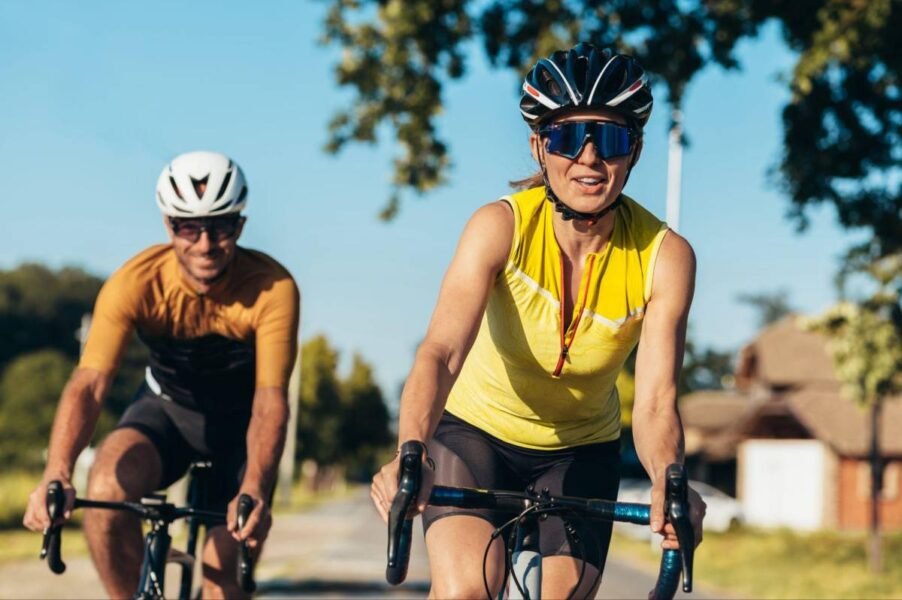
Sunglasses on a bike are not a fashion statement, whatever the pack of middle-aged men in lycra suggest. At 30km/h your eyes are dealing with wind, grit, insects, road spray and some of the harshest UV on the planet. A stone flicked up off a truck tyre is a genuine hazard, not a hypothetical one.
Choosing a decent pair is less complicated than the marketing makes out. Here is what actually matters.
What makes cycling sunglasses different?
Coverage, mostly. Riding glasses wrap around the face because a cyclist’s head is down and forward, so light arrives from angles an ordinary frame was never designed to handle. That wrap also blocks wind, which is what stops your eyes streaming halfway down a descent.
Lens material is the other difference. Polycarbonate is the standard choice because it is light and genuinely impact resistant, so debris bounces off rather than shattering into your eye.
Then there are the details that only announce themselves at speed. Frames light enough to forget you are wearing them. Arms thin enough to sit under helmet straps. Rubber grips at the nose and temples that hold on when you are sweating. Enough venting to stop the lenses fogging the moment you stop at a red light.
What do the lens categories actually mean?
Every pair sold here must be tested and labelled under AS/NZS 1067.1:2016, a mandatory standard since July 2019. The label carries a category from 0 to 4, based on how much visible light the lens lets through.
Categories 0 and 1 are technically fashion spectacles rather than sunglasses, and they cut very little glare. Category 2 offers moderate reduction. Category 3 is the workhorse for bright Australian conditions and what most riders want for daylight hours. Category 4 is very dark, intended for extreme glare such as alpine conditions, and is not suitable for driving. Worth knowing if you drive to the start of your ride.
Separately, look for UV400. That means the lens blocks wavelengths up to 400 nanometres, covering both UVA and UVB. Tint darkness and UV protection are two different things, which is where people come unstuck. A dark lens with no UV filtering is worse than wearing nothing, because your pupils open wider behind it and let more radiation in.
Tinted, mirrored or photochromic?
Grey lenses are the neutral choice. They knock brightness down without shifting colours, which is what you want when reading the road surface ahead. A mirror coating reflects more light again and earns its keep in genuinely bright conditions.
Yellow and clear lenses do the opposite job, lifting contrast in flat or dim light. They suit early starts, overcast days and rides through heavy shadow.
Photochromic lenses sidestep the problem of owning several pairs. They shift from clear to grey as the light changes, so a single lens covers a ride that begins before sunrise and finishes in full sun. If your riding spans changing conditions, they usually justify the extra outlay.
Polarised lenses are excellent at killing glare off wet roads, though plenty of riders find they make bike computer and phone screens harder to read. Try before you commit to that one.
How should they fit?
They should not move. Get out of the saddle, drop your head, hit a rough patch of road. If they shift or bounce, they are the wrong pair.
Check that the arms sit comfortably under your helmet straps without pressing behind the ears. Adjustable nose pads help if you fall between sizes, and a wider frame suits riders with broader faces. Take your helmet along when you try pairs on. A frame that fits beautifully on its own can become an irritation once the straps go over it.
What should you look for when buying?
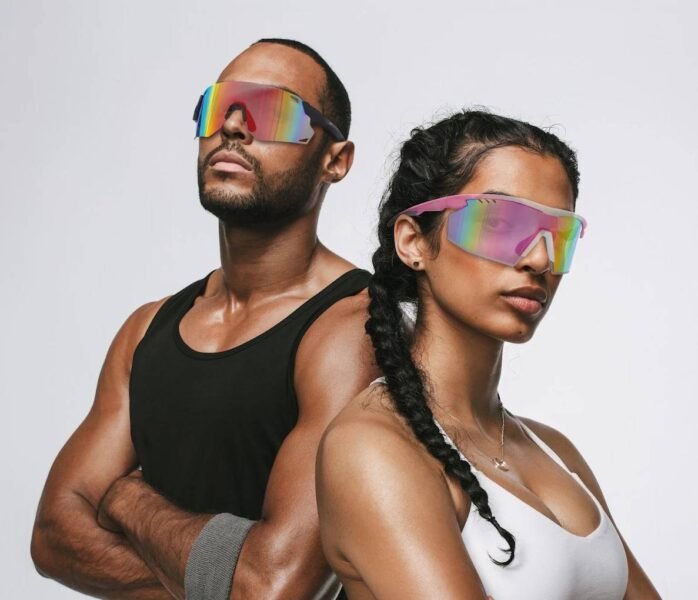
You do not need to spend a fortune. What you do need is a lens category matched to when you ride, genuine UV400 protection, polycarbonate construction, and a fit that stays put. A sensible pair of cycling sunglasses from Euro Optics that covers those four things will outperform an expensive pair chosen on looks alone.
If you ride across mixed light, prioritise photochromic. If you are mostly out in bright sun, category 3 with a mirror coating is hard to beat. And if you ride year-round, a second clear or yellow lens for dark winter mornings is a sensible addition.
Eye protection is among the cheapest pieces of cycling kit going, and one of the few that guards something you cannot replace. Get the category right, check the standard printed on the label, and make sure they stay on your face over rough ground. The rest is personal preference.