
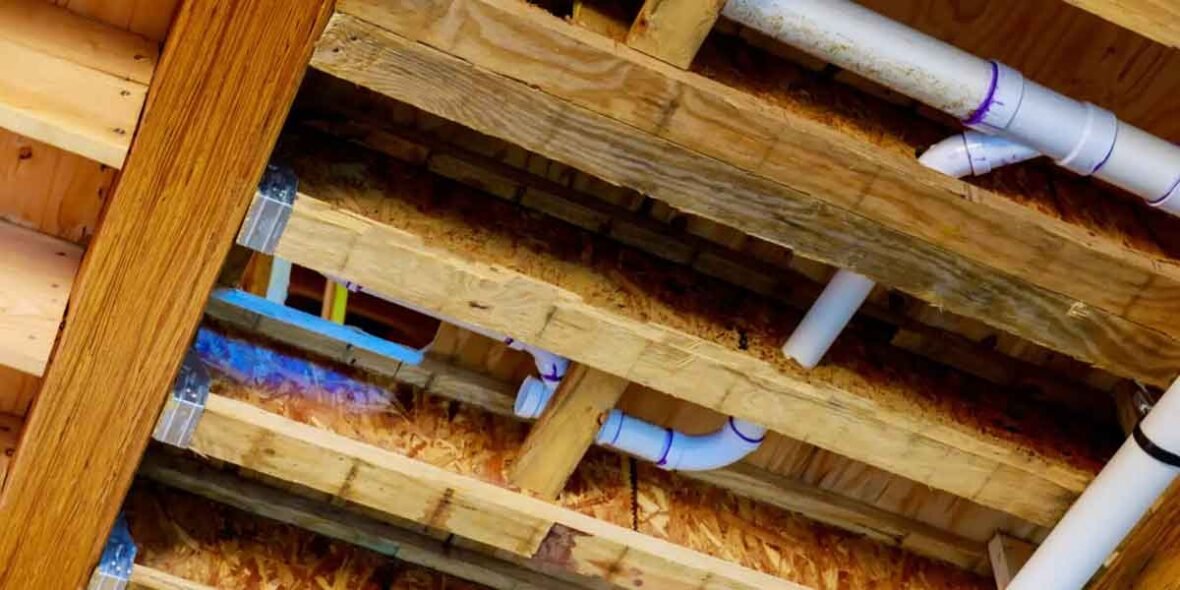
Hydro-Jetting Vs. A Whole House Repipe
Hydro-jetting is a cleaning service for drain and sewer lines. A technician sends a specialized hose through the pipe and uses controlled, high-velocity water to remove grease, sludge, mineral deposits, scale, and some root growth. The existing pipe remains in place.
A whole-house repipe replaces piping throughout the home. In most estimates, a whole house repipe refers to pressurized water-supply lines that deliver hot and cold water to fixtures. Some contractors also use it when discussing extensive drain-line replacement, so homeowners should ask exactly which pipes are included in an estimate.
This distinction matters because drain symptoms and supply-line symptoms have different causes. Slow drains and sewage backups usually involve drain or sewer piping. Low water pressure, rusty water, and pinhole leaks often involve supply piping. Sewer odors or sewage beneath the home may indicate damaged drain piping. Water stains inside walls may come from a leaking supply line, drain, fixture, or waterproofing failure.
Hydro-jetting can restore flow when the pipe is structurally serviceable. Repiping addresses deteriorated, leaking, incorrectly sized, or otherwise unreliable pipe. A camera inspection is commonly used for drain lines. Supply-line evaluation may require pressure testing, water-quality observations, exposed-pipe inspection, and a review of the home’s leak history.
This terminology can create misleading comparisons. A home may have cast-iron drains that need cleaning while its copper or PEX supply lines remain reliable. Another home may have failing galvanized supply lines and perfectly clean PVC drains. Hydro-jetting would be relevant only in the first situation.
Before comparing estimates for whole house repiping, identify the system included in each proposal: potable-water supply lines; interior drain, waste, and vent piping; the building sewer between the home and municipal connection; or a combination of these systems.
“Whole-house repipe” should never appear as an undefined line item. A whole house repipe proposal should list which branches, stacks, valves, connections, and underground sections are included. This simple clarification prevents homeowners from comparing a drain-cleaning service with a water-distribution replacement project.
Can Hydro-Jetting Delay Whole House Repiping?
Hydro-jetting can postpone drain or sewer replacement when accumulated material is causing the problem and the pipe still has adequate structural integrity. This is where it can be useful before committing to whole house repiping, provided the affected system is actually the drain or sewer piping. Removing grease, scale, sludge, and recurring deposits may restore most of the pipe’s usable diameter and reduce backups for a meaningful period.
The most defensible way to describe hydro-jetting is as capacity-restoring maintenance. The distinction is functional life versus structural life. It may provide years of additional service from a sound drain system, buy time for budgeting, or prepare a pipe for lining. Its value depends on the post-cleaning condition of the pipe and the cause of the original obstruction.
The service does not rebuild the pipe wall. Corrosion, cracks, holes, failed joints, poor slope, and collapsed sections remain after the deposits are removed. In severely corroded cast iron, cleaning can expose openings that were previously concealed by rust and scale. The cleaning reveals the pipe’s condition; it does not restore its strength.
Consider a cast-iron kitchen drain with a thick internal coating of grease and scale. Cleaning may restore enough diameter to keep that line working for several more years. A cast-iron line with a missing bottom may also drain better after cleaning, though its structural condition remains unacceptable.
A reasonable decision to postpone drain replacement requires three findings: the obstruction is removable, the cleaned pipe can contain wastewater reliably, and the expected cleaning interval is economically acceptable.
The third finding often receives too little attention. Cleaning every few years may be sensible. Cleaning every few months indicates an unresolved condition such as a belly, root-entry point, severe scaling, or structural deterioration. Maintenance history should influence the recommendation as much as a single camera recording.
When Hydro Jetting For Prevention Makes Sense
Preventive hydro-jetting makes sense when inspection and service history show that a structurally serviceable line repeatedly accumulates removable material. In these situations, hydro jetting for prevention can be more practical than waiting for another backup. Good candidates include kitchen lines with recurring grease and organic buildup, cast-iron drains that develop internal scale while retaining a sound pipe wall, sewer laterals with manageable root intrusion and no major structural failure, large households or properties with unusually heavy drain use, homes that have needed repeated cabling or snaking for the same line, and drain systems where a camera documents a predictable pattern of deposit accumulation. Root-prone sewers awaiting a planned joint repair or lining project and properties where a backup would create unusually expensive damage may also be useful preventive candidates.
Preventive jetting works best as a condition-based service. A hydro jetting for prevention schedule should be tied to documented buildup rather than a generic calendar. The maintenance interval should be based on evidence, and a blanket annual schedule has little value for a residential line with no documented buildup pattern. Start with the interval between measurable problems. If a grease-prone kitchen branch becomes restricted every 24 months, service around month 18 may prevent an interruption. If a sewer remains clear for ten years, annual jetting adds expense and introduces unnecessary equipment into the line.
Prevention should also include correcting the source of the buildup. Otherwise, hydro jetting for prevention may simply repeat the same temporary result without improving the underlying condition. Grease disposal practices, excessive food waste, root entry through defective joints, pipe bellies, and improperly connected fixtures can shorten the benefit of every cleaning. Preventive jetting becomes less useful when the cause immediately recreates the restriction. Those conditions call for corrective planning alongside any temporary cleaning.
Each service should produce comparable evidence: a baseline camera recording, footage location, estimated deposit coverage, defects observed, material removed, and post-cleaning condition. That record allows the maintenance interval to be lengthened or shortened intelligently, creating a maintenance schedule tied to the actual pipe instead of a generic calendar recommendation.
Is Hydro Jetting Safe For Old Pipes?
Old pipes can sometimes be hydro-jetted safely. The question of hydro jetting old pipes should be answered from condition, not age alone. Pipe material, remaining wall condition, joint stability, access, diameter, previous repairs, and the type of obstruction all affect the risk.
A competent technician selects the nozzle, water flow, working pressure, travel speed, and cleaning direction for the specific pipe. Maximum machine pressure is not a useful safety promise by itself. The force applied to the pipe changes with the nozzle design, distance from the wall, water volume, and how long the nozzle remains in one location.
Extra caution is appropriate when an inspection shows deep corrosion or extensive flaking, a missing or badly eroded pipe invert, holes, fractures, or visible surrounding soil, separated or severely offset joints, significant deformation or partial collapse, uncertain repairs or transitions between pipe materials, or a blockage that prevents the condition beyond it from being seen.
Pressure receives most of the attention. Water volume and debris management also matter. Pressure loosens material; flow carries it. A contractor can clean too aggressively, leave dislodged scale downstream, or cause a backup through an open fixture even when the selected pressure sounds conservative.
A responsible plan for hydro jetting old pipes should define what visible conditions would cancel the cleaning, which nozzle will be used and why, how the operator will avoid dwelling in one location, where loosened scale and debris will go, how nearby fixtures will be protected from backflow, whether the line will be recorded again after cleaning, and who is responsible if concealed deterioration is exposed.
An inspection can identify obvious reasons to avoid jetting. With hydro jetting old pipes, that inspection is especially important because hidden deterioration may remain. It cannot guarantee that every part of an old pipe wall is sound. The homeowner should receive a condition-based recommendation with stated limitations instead of a simple assurance that the pipe “passed.”
Hydro Jetting Risks For Old Cast Iron Pipes
Cast iron commonly develops internal rust, scale, channeling, and loss of material along the bottom of the pipe. Hydro-jetting can remove obstructive deposits.
One of the main hydro jetting risks for old cast iron pipes is hidden loss along the invert—the bottom of a horizontal drain. Wastewater can erode this area until a channel or opening develops. Rust scale and accumulated solids may obscure the damage during the first camera pass.
Cleaning may expose that missing material. This outcome is sometimes described as the jetter “breaking” the pipe and sometimes as the cleaning “revealing” an existing failure. The practical consequence is the same: the line may need immediate repair once the deposits are gone. That possibility should be discussed before work begins.
Other hydro jetting risks for old cast iron pipes include a deeply corroded wall failing when deposits are removed. Rust and scale can travel downstream and create a new obstruction if they are not retrieved or flushed effectively. Deteriorated connections or poorly executed repairs may shift or leak. Severe offsets, deformation, or partial collapse can catch a nozzle or hose. Improper flow control or downstream blockage can force wastewater or debris toward the home. Water jetting may remove soft buildup while leaving hard tuberculation that requires specialized descaling equipment.
Because of these hydro jetting risks for old cast iron pipes, a post-cleaning camera inspection is especially valuable with cast iron. It shows whether the newly exposed surface has ordinary pitting, isolated repairable defects, or widespread structural loss. When wall thickness remains uncertain, visual footage may need to be supplemented by laser profiling, ultrasonic testing, exposed-pipe examination, or engineering assessment.
The best risk control is a documented sequence: initial inspection, appropriately limited cleaning, debris retrieval, and post-cleaning inspection. For heavily scaled pipe, the first stage may be intended only to expose enough surface for a better diagnosis. That is an investigative cleaning scope, not a promise to restore the entire line.
Hydro Jetting Old Pipes: What A Camera Reveals
A drain camera helps the plumber identify pipe material, approximate diameter, access conditions, the type of obstruction, and visible structural defects. The technician looks for cracks, fractures, holes, corrosion, deformation, separated joints, root-entry points, standing water, scale, previous repairs, and changes in pipe material.
Several findings support controlled hydro-jetting: the camera can travel through most or all of the line, the pipe retains a consistent shape, joints appear reasonably aligned, deposits are the primary restriction, corrosion appears superficial or moderate, and there is no visible collapse, missing pipe wall, or exposed soil.
A standard sewer camera is a visual classification tool. It is not a pipe-strength test. Heavy deposits can conceal the pipe surface. Water can hide the lower portion of the line. Standard video also cannot measure remaining wall thickness or show every exterior defect. The EPA notes that CCTV provides a visual assessment of the interior above the waterline and cannot quantitatively characterize all structural deterioration.
Three inspection outcomes are possible: suitable for cleaning when there are no significant visible structural defects and the obstruction is removable; unsuitable for cleaning when visible failure creates an unacceptable risk; or condition uncertain when deposits or water prevent an adequate view.
The third outcome requires judgment. For uncertain lines, inspection may be staged. The plumber records the initial condition, performs limited low-risk cleaning, reinspects the exposed surface, and then decides whether additional jetting is appropriate. Other options include access from another direction, exposed-pipe examination, or a more specialized assessment.
Homeowners should request footage from before and after cleaning and defect locations. The post-cleaning video often contains the more useful structural information because the pipe surface is finally visible.
Hydro Jetting: Uses And Limits
Hydro-jetting is suited to restrictions that can be removed from a serviceable drain pipe. These include grease and food residue, soap sludge and organic buildup, loose sediment, some mineral deposits and cast-iron scale, certain root intrusions, debris left after conventional drain cleaning, and recurring buildup spread along a long section of pipe.
The most useful dividing line is whether the problem occupies the pipe or is part of the pipe.
Some cases require a combined approach. Roots can be cleared, while the joint or crack admitting them still needs sealing. Cast-iron scale can be removed, while severe wall loss may require lining or replacement. A belly can be cleaned, while solids will continue to settle until the grade is corrected. A damaged section can receive a point repair while the remaining pipe stays in service.
Repiping should also be separated from rehabilitation. A structurally suitable sewer may qualify for lining, while an isolated defect may need only sectional replacement.
A complete recommendation should therefore contain two diagnoses: what is restricting flow today and what condition is likely to cause the next failure.
Signs You Need Home Repiping
No single household symptom proves that every pipe must be replaced. Whole-house repiping becomes the most reasonable recommendation when testing and repair history show deterioration throughout the system. In that situation, home repiping is based on documented system-wide failure rather than a single clog or isolated defect.
For water-supply piping, strong indicators for home repiping include repeated leaks appearing in different parts of the house; numerous old patches or abandoned pipe sections; widespread corrosion on exposed piping and fittings; persistently discolored water from multiple cold-water fixtures; poor flow throughout the home after valves, the meter, pressure regulator, and service line have been checked; galvanized piping with extensive internal restriction; pipe material that cannot be repaired reliably or is creating a documented health concern; and repair costs accumulating without restoring dependable service.
Homeowners should ask the contractor to map the evidence by location using video footage, pressure readings, leak records, photographs, and a written explanation. The map should identify which pipe sections have failed, which sections remain serviceable, which observations are visible on camera, which conclusions come from age or material alone, why spot repair, partial repiping, or lining is unsuitable, and which portions are inaccessible and therefore uncertain.
This approach may still lead to a whole-house repipe. When the evidence is widespread, home repiping may be more defensible than continuing isolated repairs. It also produces a recommendation tied to documented failure instead of a broad claim based on the home’s construction year.
Whole House Repipe Vs. Hydro-Jetting: Cost And Lifespan
Hydro-jetting is generally a service-level expense, commonly ranging from several hundred dollars into the low thousands. Access difficulty, line length, pipe diameter, blockage severity, camera work, root cutting, and debris removal influence the final price.
Whole-house repiping is a construction project. The cost of whole house repiping reflects the broader scope of replacing piping throughout the home. Costs commonly reach several thousand to tens of thousands of dollars, depending on the home’s size, number of fixtures, pipe material, access through walls or slabs, permits, regional labor rates, and the amount of finish repair required. Drain replacement beneath a slab can cost substantially more than accessible supply-line work.
The two services also deliver different forms of longevity. Hydro-jetting has a cleaning interval, not a pipe-life warranty. The benefit lasts until deposits accumulate again, which may be months or several years. Pipe condition, usage, slope, root entry, and maintenance practices determine the interval. Properly selected and installed repiping is intended to provide decades of service, not a guarantee against every future clog or installation defect. A whole house repipe is therefore a capital improvement rather than a maintenance service. Longevity depends on material, water chemistry, operating pressure, installation quality, soil conditions, and building movement.
A useful estimate should separate inspection, cleaning, repairs, permits, wall or floor restoration, warranties, and exclusions. For jetting, ask what happens if cleaning reveals a failed pipe.
The useful comparison is the expected cost of maintaining service over time. The lowest immediate price does not always produce the lowest long-term cost. Homeowners can estimate the maintenance path with a simple calculation:
Expected maintenance cost = service price × likely number of cleanings during the planning period
Add the financial exposure from backups, emergency calls, property damage, and interrupted use. Then compare that total with repair, lining, or replacement.
Whenever the existing drain remains usable, request two written options: a maintenance option showing the expected cleaning interval and unresolved defects, and a capital option showing the replacement or rehabilitation scope, restoration costs, warranty, and expected service life.
That comparison gives the homeowner a decision based on ownership cost, risk, and remaining pipe condition.