
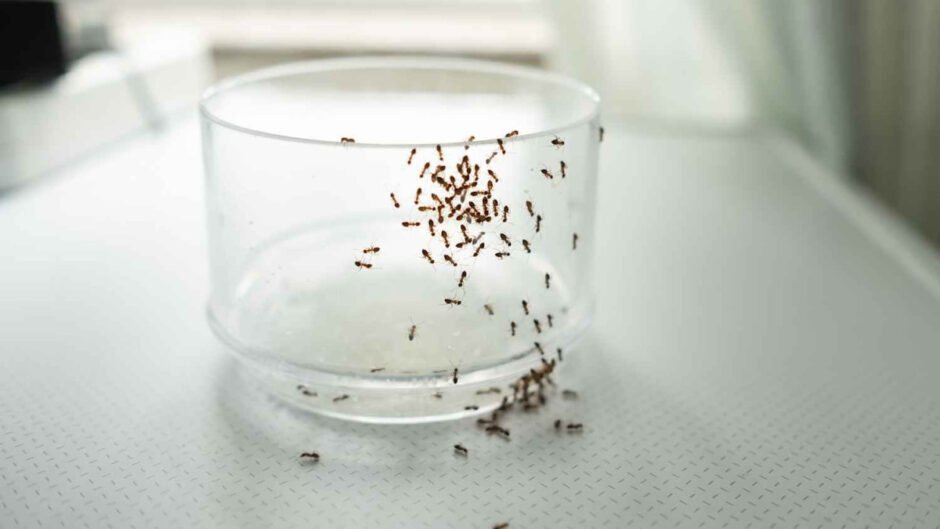
They are smaller than a sesame seed. Pale yellow or translucent brown. You can barely see them individually, but there are hundreds of them forming a thin moving line from the outlet cover to the honey jar. These are not the standard dark sugar ants most people deal with. These are almost certainly pharaoh ants or thief ants, and they are the hardest household ant to eliminate.
The reason is a survival mechanism called budding. When a pharaoh ant colony senses a threat, the queen does not stay and fight. She splits the colony. Workers carry larvae and pupae to new locations and establish satellite nests. A single spray of insecticide can turn one colony into four scattered across your kitchen, bathroom, and laundry room. Most of the standard ant advice on the internet makes pharaoh ants worse.
Here is what actually works, and more importantly, what to avoid doing at all costs.
Know Your Enemy: Pharaoh Ant vs. Thief Ant vs. Odorous House Ant
Pharaoh ants are about one sixteenth of an inch long. They are pale yellow to light brown with a darker abdomen. Under magnification, they have a two-segmented waist. They prefer protein and fat but will accept sugar, especially in spring and early summer when colonies are producing new reproductives.
Thief ants are even smaller, sometimes less than one thirty-second of an inch. They are yellow to light brown and are named for their habit of nesting near other ant colonies and stealing their food and larvae. They strongly prefer protein and grease and often ignore sugar baits entirely.
Odorous house ants, covered in separate guides, are dark brown to black and larger. They also bud but less aggressively than pharaoh ants. The key distinction for treatment is size and color. If the ants are so small you struggle to see individual body segments, you are dealing with pharaoh or thief ants. If they are dark and you can clearly see legs and antennae, they are likely odorous house ants and the standard sugar bait protocol applies.
What Never to Do With Tiny Tiny Ants
Do not spray them with insecticide. Not even a little. Not even the one ant that got on your arm. Spraying triggers budding. The colony splits, and you now have ants in rooms that were previously ant-free. This is not a possibility. It is a near certainty with pharaoh ants.
Do not clean the trail with bleach, ammonia, or strong disinfectants. The chemical stress from these cleaners triggers the same budding response as insecticide. Use only warm soapy water to wipe trails, and only after bait stations are already in place and the colony is feeding on them.
Do not use foggers or bug bombs anywhere in the house while treating for pharaoh ants. The whole-house insecticide exposure is the maximum possible colony stressor. It will cause budding on a house-wide scale. What was a kitchen problem becomes an every-room problem.
Do not squish them. The scent of crushed pharaoh ants releases alarm pheromones that alert the colony to danger. This contributes to budding risk. If you must remove visible ants while bait is working, use a vacuum cleaner and dispose of the bag outside immediately.
The Bait Strategy for Budding Ant Species
Bait is the only method that works for pharaoh and thief ants, but it must be deployed differently than for other ant species. The goal is to feed the entire colony without alarming it.
Place multiple small bait placements rather than one or two large ones. Pharaoh ants forage in narrow trails and may not discover a single bait station. Place at least four to six bait placements around the kitchen: behind the sink, in the corner of the counter where the trail enters, under the cabinet overhang, behind small appliances, and along the baseboard where ants travel.
Use a mix of bait types from the start. Pharaoh ants switch food preferences seasonally and even weekly. Place a sugar-based liquid bait and a protein-based gel bait side by side at each location. The ants will choose what the colony currently needs. Do not wait to see if they accept one before trying the other. Put both out on day one.
Recommended baits for pharaoh ants include Advion Ant Gel with indoxacarb, which is effective against both sugar and protein feeders, and Maxforce Quantum, which uses imidacloprid in a gel matrix that pharaoh ants readily accept. For thief ants, which prefer protein, Advance 375A protein bait with abamectin is more likely to be taken than sugar-based baits.
Do not use Terro liquid ant bait for pharaoh ants. Terro is a borax and sugar solution. Borax kills too quickly for pharaoh ants. Workers die before reaching the nest. The colony detects the sudden forager loss, buds, and the problem spreads. Terro is effective for odorous house ants. It is not recommended for pharaoh or thief ants.
Replace bait every two to three days. Pharaoh ant bait that has dried out or spoiled is ignored. Fresh bait keeps the colony feeding consistently. Expect to replace bait placements four to six times over a two-week treatment period.
The Pharaoh Ant Elimination Timeline
Pharaoh ant elimination takes longer than other ant species. The colony structure is more complex, with multiple queens and the ability to bud when stressed. Set expectations accordingly.
Days 1 through 3. Ants discover bait stations and begin feeding. Activity at bait placements increases as workers recruit nestmates. This is good. Do not disturb the feeding ants.
Days 4 through 10. The active ingredient spreads through the colony via trophallaxis. Workers, larvae, and some queens begin dying. You may notice a reduction in trail activity but not elimination. Pharaoh ant colonies often have dozens of queens. It takes time for the poison to reach all of them.
Days 10 through 21. Colony collapse accelerates as queen mortality increases. Without queens, no new workers are produced. The remaining workers die naturally over this period. Trails thin and eventually stop.
Day 21 and beyond. If activity continues past three weeks, the bait was not reaching all colony fragments. This is common in homes with pharaoh ants nesting in multiple wall voids. A professional pest control operator with access to non-repellent sprays and professional-grade baits may be needed. Pharaoh ant elimination by a professional typically takes four to eight weeks with multiple visits.
Finding Pharaoh Ant Nests Without Disturbing Them
Pharaoh ants nest in warm, humid, inaccessible locations. Common nest sites include wall voids near hot water pipes, the hollow spaces inside curtain rods and shower rods, behind electrical outlet covers on exterior walls, inside the insulation of refrigerators and dishwashers, and in the folds of fabric stored in warm closets.
You do not need to find the nest to eliminate it. Bait placed on foraging trails is carried back to the nest regardless of its location. However, identifying likely nest locations helps explain why the ants keep appearing in specific rooms and informs long-term sealing efforts after elimination.
If you find a nest during treatment, do not disturb it. Do not vacuum it. Do not spray it. Note the location. Continue baiting. The colony is being poisoned systemically through the bait. Disturbing the nest triggers budding and resets your progress.
Special Considerations for Apartments and Multi-Unit Buildings
Pharaoh ants in apartments are a building-wide problem. They travel between units through wall voids, plumbing penetrations, and electrical conduits. Treating only your unit while a neighbor’s unit remains infested guarantees reinfestation.
Notify the landlord in writing. Pharaoh ant infestations in multi-unit buildings require coordinated treatment. Every unit on the affected floor, plus units directly above and below, must be baited simultaneously. If only one unit is treated, ants from untreated units repopulate the treated unit within weeks.
This is one of the few pest situations where professional treatment is effectively mandatory for apartments. Consumer bait placed in one unit cannot overcome the pressure from untreated adjacent units. The landlord must hire a pest control company that understands pharaoh ant protocols and treats the entire affected zone at once.
After Elimination: Seal and Prevent
Once you have gone two weeks with zero ant activity, begin sealing. Caulk gaps around countertops, backsplashes, window frames, and pipe penetrations under sinks. Seal around electrical outlet covers on exterior walls with foam gaskets, which cost about two dollars for a pack of ten at any hardware store.
Eliminate food access permanently. Pharaoh ants can survive on microscopic food residues. The film of grease on the range hood filter. The dust of powdered sugar in the baking cabinet. The drip of syrup dried on the outside of the bottle. Clean at a level that feels excessive. Wipe cabinet shelves with warm soapy water. Store all pantry items in sealed containers.
Monitor with sticky traps placed in the backs of cabinets and behind appliances. Check them monthly. A single pharaoh ant on a trap means a scout has found its way in and the colony is still active somewhere in the building. If you catch a scout, do not react with spray. Place fresh bait immediately and prepare for a potential new trail.
Frequently Asked Questions
Why are tiny tiny ants so much harder to get rid of than regular ants?
Pharaoh ants and thief ants use budding as a colony defense mechanism. When the colony detects a threat, queens produce new reproductives and workers carry brood to new locations, establishing satellite nests. This turns one colony into multiple colonies. Standard household insecticides and cleaning chemicals trigger this response. The ants are also much smaller, which means they have more potential entry points and nest sites that are difficult to locate and treat directly. Patience and bait consistency are the only reliable approaches.
Why did my DIY bait fail?
Three common reasons. First, the bait used borax as the active ingredient. Borax kills pharaoh ants too quickly. Workers die before reaching the nest, the colony detects the loss, and budding occurs. Second, the bait was only one food type. Pharaoh ants switch between sugar and protein. A sugar-only bait fails when the colony is in a protein-feeding phase. Third, the bait was not replaced frequently enough. Pharaoh ants ignore dried or spoiled bait. Replace every two to three days.
What if the ants ignore every bait I put out?
This happens most often with thief ants, which are extremely selective feeders. Try a minute amount of the food source the ants are currently foraging on mixed with a commercial protein bait. If they are feeding on grease behind the stove, mix a small amount of that grease into Advance 375A. If they are feeding on a specific item in the pantry, incorporate a trace of it into the bait. The familiar scent draws them in. Once they accept the bait with the familiar food mixed in, gradually reduce the familiar component over subsequent bait replacements.
At what point do I need a professional for these ants?
If you have followed the no-spray, dual-bait protocol for three weeks with no reduction in activity, the colony is likely too large or too widely distributed for consumer bait to reach all fragments. If you live in an apartment or multi-unit building, professional treatment is effectively required from the start because the infestation spans multiple units. Professional pharaoh ant treatment uses non-repellent insecticide sprays that ants cannot detect, combined with professional-grade baits that are not available to consumers. Expect to pay $200 to $400 for an initial treatment and $100 to $150 per follow-up visit over a four to eight week program.