
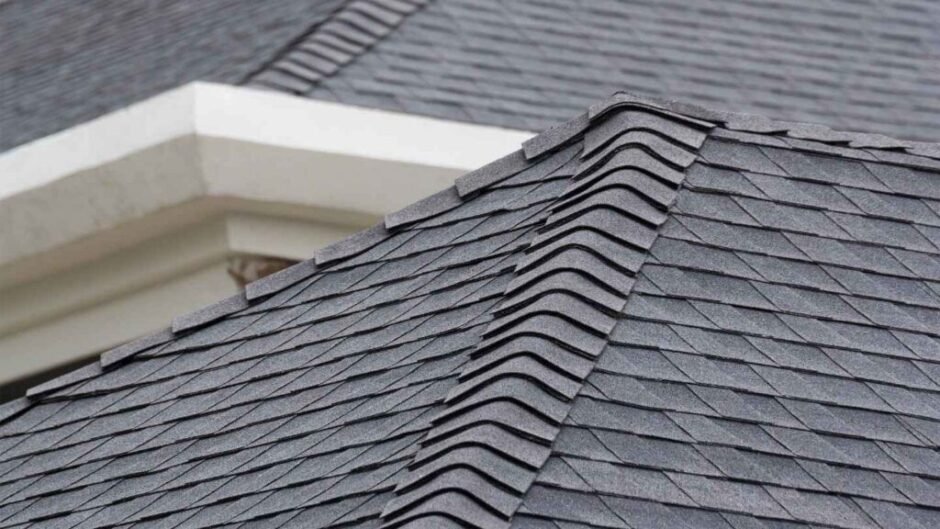
A typical shingle roof — meaning an architectural asphalt shingle roof, which is what roughly 80% of homes in the United States have — lasts 22 to 28 years in practice, regardless of what the warranty says. The shingle manufacturers print “30-year” or “lifetime” on the wrapper, but those numbers assume perfect installation, perfect attic ventilation, a moderate climate, and a roof that is never walked on, never hit by a tree branch, and never subjected to a hailstorm. In the real world, the roof reaches year 22 and the south-facing slope is showing its age. By year 28, the homeowner is getting quotes for a replacement.
A three-tab shingle roof — the older, flatter style with the three rectangular cutouts — lasts 15 to 20 years. These are the shingles on houses built before roughly 2005, and if your roof still has them and they are original, the roof is past its design life and should be replaced before it leaks. Three-tab shingles are still sold, but they are rarely installed on new roofs because architectural shingles cost only $1 to $2 more per square foot and last 5 to 10 years longer. The economics of three-tab shingles do not work for anyone who plans to own the house longer than a decade.
Asphalt Shingle Lifespan by Type
| Shingle Type | Marketing Lifespan | Real-World Lifespan | Installed Cost / sq ft | Cost per Year |
| 3-Tab | 20-25 years | 15-20 years | $4-$5 | $0.22-$0.30 |
| Architectural (Dimensional) | 30-year / Lifetime | 22-28 years | $5-$7 | $0.20-$0.28 |
| Designer / Luxury | Lifetime / 50-year | 30-40 years | $8-$12 | $0.23-$0.33 |
The gap between the marketing lifespan and the real-world lifespan is not a scam — it is the difference between laboratory conditions and the conditions on your roof. The ASTM testing that produces warranty ratings subjects shingles to controlled heat, UV, and moisture cycling. It does not account for the oak tree that drops branches on the north slope, the bathroom fan that vents into the attic instead of through the roof, the original installer who used three nails per shingle instead of four, or the 140°F attic that bakes the shingles from underneath every July afternoon. Every one of those real-world conditions shortens the roof’s life by a year or two. Cumulative, they shorten it by 5 to 8 years.
What Shortens the Life of a Typical Shingle Roof
Six factors separate a roof that lasts 28 years from one that fails at 18. None of them are the shingle brand. The shingle itself is a commodity product — a fiberglass mat coated in asphalt and covered in ceramic granules. The asphalt comes from the same refineries, and the granules come from the same quarries, regardless of whose name is on the wrapper. The installation, the ventilation, the climate, and the maintenance determine the lifespan.
- Attic ventilation. The single most overlooked factor — and the one that costs nothing to fix during a roof replacement. An attic that reaches 140°F in summer bakes the shingles from underneath. The asphalt softens, loses volatile oils faster, and the shingles curl and crack at the edges. A properly ventilated attic — ridge vent plus continuous soffit vents — stays within 10°F to 15°F of the outdoor temperature. That alone adds 5 to 8 years to the roof’s life. It also keeps the attic dry, preventing the roof deck from rotting from condensation.
- Installation quality. Shingles nailed too high (above the nail line), too low (through the seal strip), with too few nails (three instead of the code-required four or the wind-zone-required six), or over-driven (puncturing the mat) will fail years before the shingle material itself would. The installer is more important than the brand. A GAF Timberline shingle installed by a careless crew fails sooner than an off-brand shingle installed by a meticulous crew.
- Climate and sun exposure. The south-facing roof slope receives direct sun for the longest portion of the day and will show granule loss, curling, and cracking 5 to 7 years before the north-facing slope on the same roof. Homes in hot climates — Phoenix, Las Vegas, south Florida — get 18 to 22 years from an architectural roof that would last 25 to 28 years in a moderate climate. The sun, not the rain, is what kills asphalt shingles.
- Roof pitch. Steeper roofs last longer — the water runs off faster, the debris does not accumulate, and the shingles dry faster after rain. An architectural shingle on a 12:12 pitch in a moderate climate lasts 25 to 30 years. The same shingle on a 4:12 pitch in the same climate lasts 20 to 25 years. The low-slope roof holds water longer, holds debris longer, and the sun hits it at a more direct angle.
- Trees. Overhanging branches scrape the shingle surface in the wind, wearing through the granules in a linear pattern. Wet leaves that pile up in valleys and behind chimneys hold moisture against the shingles for weeks. Moss and algae colonies on shaded roof faces retain water and produce mild acids that attack the asphalt. Trimming branches and cleaning debris costs nothing and adds years.
- Walking on the roof. Every time someone walks on an asphalt shingle roof — the satellite dish installer, the chimney sweep, the homeowner hanging Christmas lights — they scuff granules off the shingle surface. Over 20 years, the accumulated foot traffic creates bald spots at the access points. The roof that has been walked on regularly will fail at those traffic paths first.
The “lifetime warranty” reality: A lifetime limited warranty on an architectural shingle covers manufacturing defects for as long as the original purchaser owns the home. It does not cover normal weathering, granule loss, curling, or cracking from age — which are the reasons shingle roofs are actually replaced. The warranty is prorated: after year 10, the manufacturer reimburses a declining percentage of the shingle cost only (not labor). By year 20, the warranty typically covers 20% to 30% of the shingle material cost, which is roughly $300 to $500 toward a $12,000 roof replacement. The warranty is a marketing document, not a lifespan promise.
How to Tell If a Typical Shingle Roof Needs Replacement
A shingle roof does not fail on a single Tuesday afternoon. It sends signals for years — signals that are visible from the ground or from a ladder at the eave. Recognizing those signals tells you how many years are left and whether you need to budget for replacement now or can wait.
- Curling shingle edges: Year 18 to 22. The shingle tabs curl upward, away from the deck. Curling means the asphalt has lost its flexibility. A curled shingle catches wind and will tear off in the next storm.
- Bald spots: Year 20 to 25. The granules are gone, the black asphalt coating is exposed, and UV radiation is attacking the underlying mat directly. A few bald spots are normal on an older roof. Bald spots across more than 25% of a roof face mean replacement.
- Granules in the gutters: Year 15 onward, accelerating. Every asphalt roof sheds granules. Heavy accumulation — enough to form a layer of grit in the gutter — on a roof over 15 years old means the shingles are eroding rapidly.
- Cracked shingles: Year 22 to 28. A shingle cracked through the mat is no longer waterproof. A few cracked shingles can be replaced. Cracked shingles across multiple faces mean the roof is failing systematically.
- Missing shingles after routine wind: Any age, but more common after year 15. Shingles that blow off during a 30 mph gust had already lost their seal adhesion. The wind exposed a pre-existing condition.
Does Installing a Second Layer Affect Lifespan?
Installing a second layer of shingles over an existing layer — an overlay — reduces the new roof’s lifespan by 10% to 20%. The shingles cannot lie as flat over an uneven surface, the trapped heat between the two layers accelerates asphalt degradation, and the weight of the additional layer stresses the roof structure. A 30-year architectural shingle installed as an overlay will last 24 to 27 years instead of 27 to 30.
Building codes limit roofs to two layers of shingles. If your current roof is already a second layer, the next replacement requires a full tear-off — both layers come off down to the deck. The tear-off cost for two layers is roughly double the cost for one layer. The $2,000 to $4,000 saved by skipping the tear-off today becomes a $4,000 to $8,000 tear-off cost on the next replacement.
FAQ: Common Questions About Shingle Roof Lifespan
Do more expensive shingle brands last longer?
Not in a way that is statistically significant. A GAF Timberline HDZ, an Owens Corning Duration, and a CertainTeed Landmark are functionally identical products — laminated fiberglass-asphalt architectural shingles — manufactured to the same ASTM D3462 standard. The difference in lifespan between the three brands on the same house with the same installer is negligible. The price difference reflects marketing, distribution, and the warranty terms, not a measurable difference in product longevity.
Can I improve my attic ventilation now to get more years out of my existing roof?
Adding ventilation to an existing roof will slow further degradation but will not reverse the damage that has already been done. A 15-year-old roof that has been baking in a poorly ventilated attic has already lost a significant portion of its asphalt’s volatile oils to heat exposure. Adding a ridge vent and soffit vents now will extend the remaining life — perhaps by 2 to 4 years — but it will not restore the 5 to 8 years of life that were already lost. The ventilation upgrade is most effective when it is done during a roof replacement, so the new shingles start their life in a cool attic.
Budget for Replacement at Year 22, Not Year 30
The 30-year architectural shingle roof is a marketing concept. The 22- to 28-year roof is the reality on your house. If your roof is 20 years old and it was installed correctly over a well-ventilated attic, it has roughly 2 to 8 years left — less if the south-facing slope is showing its age, more if the house is shaded and the climate is mild.
Start budgeting for replacement at year 20. If the roof makes it to year 28, you have a pleasant surprise and a fully funded replacement account. If it fails at year 22 — which is what the real-world data says is typical — you are prepared instead of scrambling for financing while water drips through the ceiling.