
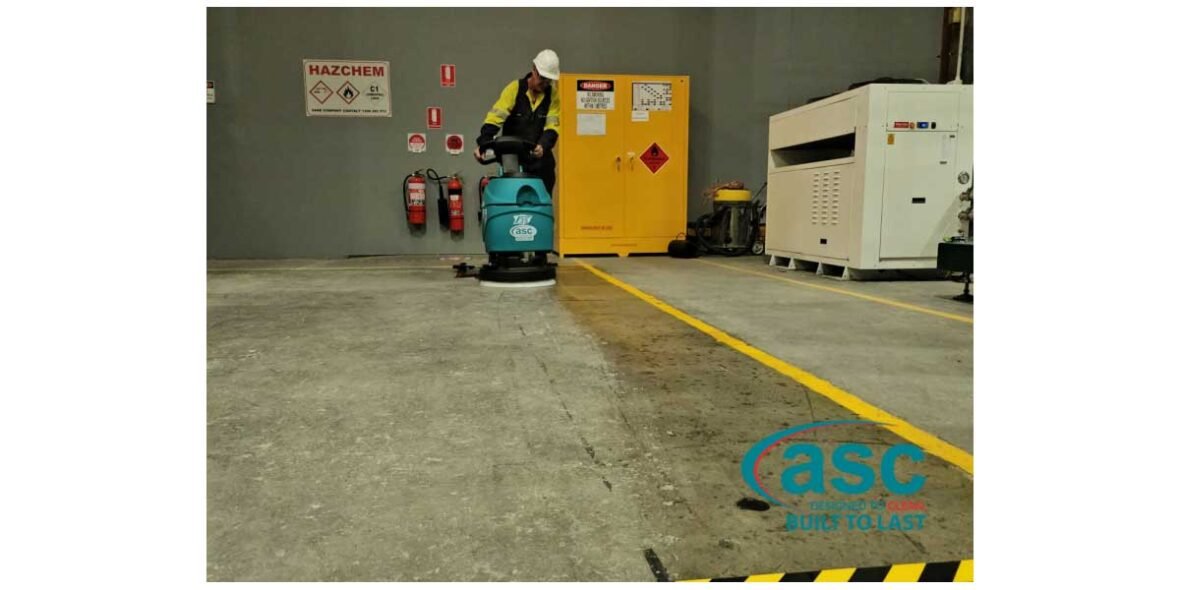
At 6:30 a.m., the roller doors lift. A logistics team prepares for inbound freight. Overnight, dust settles across polished concrete. The cleaning crew stands at a crossroads: push a compact machine across aisles for the next three hours or climb onto a ride-on unit and finish before the first truck docks.
That decision isn’t about preference. It’s about productivity, labour cost, and operational scale.
If you’re choosing between a walk-behind floor scrubber and a ride-on model, the right answer depends on space, budget, and how quickly your business moves.
Let’s break it down clearly.
Productivity: How Much Floor Are You Cleaning?
Decisions about cleaning equipment should start with measurable output. But within mechanised systems, there’s another leap.
| Machine Type | Avg. Productivity (m²/hour) | Best For |
| Walk-behind floor scrubber | 1,000–2,000 | Retail stores, schools, small warehouses |
| Ride-on scrubber | 3,000–7,000+ | Large warehouses, factories, airports |
If your facility exceeds 2,500–3,000 m² of daily cleaning, a ride-on unit can dramatically reduce cleaning time.
If you clean under 1,500 m² with tight corners and shelving, a walk behind floor scrubber remains efficient and cost-effective.
Labour Cost: Where Efficiency Becomes Financial
Cleaning decisions aren’t just operational, they’re financial. If one operator spends four hours daily using a walk-behind system:
4 hours × 5 days × average hourly wage = significant annual labour cost.
A ride-on scrubber often halves that time in large spaces.
Faster cleaning means:
Less downtime
- Reduced wet-floor exposure
- Improved safety compliance
Time savings and safety improvements both affect your bottom line.
Facility Type: Match Environment to Machine
This is where most businesses go wrong. They make purchases based on price, not design.
Choose a Walk-Behind If:
- Your institution has small aisles.
- You work in small retail conditions.
- Storage space involves narrow curves.
- The cleaning would be made during open hours.
- The leading ones are budget constraints.
A walk behind floor scrubber offers flexibility. The operators move about displays, desks and shelves with ease. Initial maintenance is also cheaper.
Choose a Ride-On If:
- You are in control of open warehouse floors.
- You clean over 3,000 m² regularly
- You have distribution centres.
- You need a thorough cleaning every day.
- Speed has a direct effect on operations.
Ride-on units are predominant in open-plan areas, where very long, direct lines of cleaning are most efficient.
Operator Fatigue: The Forgotten Factor
Hand mopping is tiring to the employees. Machine walkers lead to strain reduction. Ride-on machines minimise it further.
Fatigue affects:
- Cleaning consistency
- Speed
- Workplace safety
- Staff morale
In industrial settings with high output, operator comfort is a concern. The ride-on seating system enables employees to keep pace during long working shifts.
In the case of facilities operating in more than one shift, that benefit multiplies fast.
Maintenance and Storing
A walk behind floor scrubber typically:
- Requires less storage space
- Costs less upfront
- Fits companies that have little parking or charge space.
Ride-on scrubbers:
- Need a special charging area.
- Need more initial capital.
- Realise long-term payback in massive plants.
Space constraints are usually traded for a reduced volume of cleaning.
Growth Stage Matters More Than Current Size
Many businesses buy equipment based on today’s footprint. Smart operators buy based on next year’s expansion.
If you plan to:
- Expand warehouse capacity
- Increase inventory turnover
- Add production lines
- Extend trading hours
Investing in a ride-on machine early prevents operational bottlenecks later.
However, if your growth trajectory remains stable and your facility remains compact, a walk behind floor scrubber continues to serve efficiently.
The “3-Step Audit” for Facility Managers
To make the right choice, ask your team these three questions:
- What is the “Minimum Aisle Width”?Measure your narrowest point. If it’s under 1.2 metres, a large ride-on will struggle. A walk-behind is your best bet.
- How long is the cleaning window?If you only have a 60-minute window to clean a 4,000 m² loading dock, you need the speed of a ride-on.
- Who is the operator?If you have a high-turnover casual workforce, the simplicity of a walk-behind reduces training time and the risk of damage.
When Should You Choose a Walk-Behind Floor Scrubber?
Choose a walk behind floor scrubber when:
- Your space includes tight layouts
- You clean in smaller sections
- Budget constraints limit capital investment
- Your facility is under 30–40k square feet
- Cleaning frequency is moderate
Walk-behind machines deliver reliable performance in compact and mid-sized commercial environments.
When Should You Choose a Ride-On?
Choose ride-on when:
- Floor space exceeds 50k square feet
- Cleaning disrupts production
- Labour costs are increasing
- Safety compliance requires consistent dry floors
- Growth is expanding your cleaning demand
Ride-on scrubbers excel in industrial, warehouse, retail complex, and high-traffic commercial environments.
The Bottom Line
Here’s the straight answer:
- Choose a walk behind floor scrubber for compact, high-detail environments where manoeuvrability matters more than speed.
- Choose a ride-on scrubber for large, open commercial or industrial spaces where productivity directly affects revenue.
Neither machine is “better.” The wrong match is the real problem.
When cleaning becomes slow, labour-heavy, or disruptive to operations, that’s your signal to upgrade. Make the decision based on floor size, operational pressure, and growth, not just budget.
Because in commercial environments, clean floors don’t just look better.
They run better.