
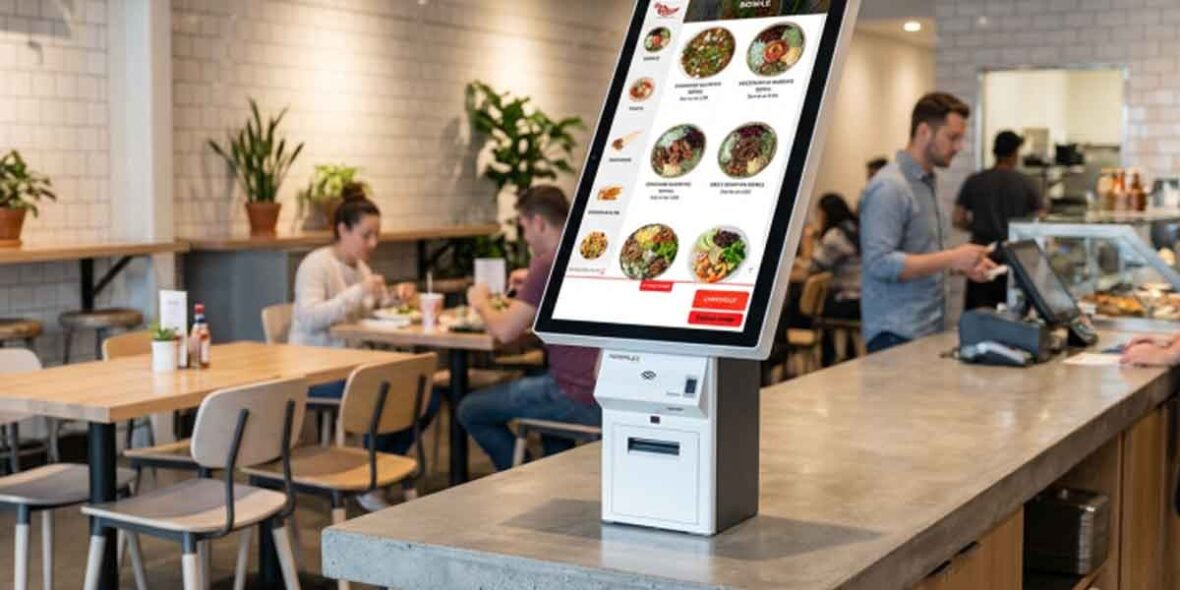
The year is 2026, and the “novelty” of digital ordering has long since evaporated, replaced by a sophisticated, autonomous reality. If you walk into a thriving quick-service restaurant (QSR) or a bustling urban bistro today, you aren’t just looking for a meal; you are looking for a friction-free experience. The hospitality industry has hit a massive turning point where the food ordering kiosk is no longer a “nice-to-have” gadget bolted to the floor; it is the very engine driving the self-service boom.
For restaurant operators, this isn’t just about saving a few bucks on labour. It’s a total reimagining of how “kai” (food) meets the customer. We’ve moved past the clunky, unresponsive touchscreens of the early 2020s into an era of hyper-personalised, AI-driven concierges that know what you want before you’ve even tapped “Start.”
-
Quick-Service Restaurants: Where Speed Meets Volume
Quick-service venues face a unique challenge: serving massive customer volumes during compressed peak periods whilst maintaining the speed that defines the segment. Traditional counter service creates unavoidable bottlenecks where even the fastest staff can only process one order at a time, whilst customers queue impatiently, checking their watches.
How self-service transforms QSR operations:
- Multiple customers order simultaneously instead of waiting sequentially, multiplying throughput without adding staff
- Peak lunch rushes that previously meant 15-minute queues now flow smoothly through distributed ordering points
- Order accuracy improves dramatically when customers input their own modifications and see visual confirmation
- Upselling happens systematically rather than sporadically, with combo suggestions appearing at optimal moments
- Labour deployment shifts from transaction processing to food preparation and quality assurance
-
Cafés and Coffee Shops: Balancing Efficiency with Atmosphere
Café culture thrives on atmosphere and connection, which initially made many operators hesitant about introducing technology they worried might feel impersonal. The reality? Smart implementation of a food ordering kiosk actually enhances the café experience by eliminating the friction points that previously frustrated both customers and staff.
The café-specific benefits:
- Morning coffee rushes become manageable without overwhelming small teams
- Baristas focus entirely on coffee quality rather than juggling order-taking and preparation
- Customers browse food options visually whilst waiting for their drinks, increasing food attachment rates
- Complex customisations (extra hot, half-strength, oat milk, two sugars) arrive clearly at the coffee station
- Regular customers can save their usual orders for one-tap reordering
The key to successful café implementation lies in maintaining the human warmth that defines café culture whilst removing the transactional friction that creates stress.
-
Food Courts and Multi-Vendor Venues: Solving Complexity
Food court environments present unique challenges that make self-service ordering particularly valuable. Multiple vendors, shared seating, varying price points, and high customer turnover create complexity that traditional ordering methods struggle to manage efficiently.
Why food courts embrace ordering technology:
- Unified ordering systems across multiple vendors reduce confusion and streamline operations
- Customers browse all vendor options from a single interface rather than queuing at multiple counters
- Table service becomes feasible when orders clearly indicate seating locations
- Payment reconciliation across vendors happens automatically rather than requiring manual processing
- Peak period capacity increases dramatically when orders are distributed across multiple touchpoints
Table location technology transforms food court service models, too. When customers can indicate their seating location during ordering, vendors can deliver food directly rather than relying on order number callouts that create chaos during busy periods.
This evolution from counter collection to table delivery elevates the entire food court experience, making it competitive with traditional restaurant service whilst maintaining the variety and value that defines the format.
-
Fine Dining and Upscale Casual: Technology Meets Sophistication
The perception that self-service ordering suits only quick-service environments is rapidly dissolving as upscale venues discover how thoughtfully implemented technology can enhance rather than diminish premium dining experiences.
How fine dining venues leverage ordering technology:
- Wine and beverage ordering from table-mounted tablets supplements rather than replaces sommelier service
- Course pacing controls let customers indicate when they’re ready for the next dish
- Dietary preferences and allergen information integrate seamlessly into ordering workflows
- Premium upselling through high-quality photography showcases special offerings effectively
- Split payment handling accommodates complex group dining scenarios gracefully
The Auckland fine-dining establishment experimenting with tableside ordering technology made a crucial discovery: customers appreciated having detailed wine information, tasting notes, and pairing suggestions available digitally, whilst maintaining the option to consult their sommelier for complex selections.
This hybrid approach provided autonomy for confident guests whilst preserving human expertise for those seeking guidance, the best of both worlds.
-
Healthcare and Institutional Settings: Accessibility and Efficiency
Hospital cafeterias, university food services, and corporate dining facilities share unique requirements around dietary accommodation, payment methods, and accessibility that make thoughtfully designed ordering technology particularly valuable.
Institutional application benefits:
- Multilingual interfaces serve diverse populations without requiring multilingual staff
- Allergen filtering helps vulnerable populations navigate safe food choices
- Cashless payment accommodates institutional meal plans and prepaid systems
- Accessibility features ensure everyone can order independently, regardless of disability
- Off-peak ordering availability serves shift workers and unconventional schedules
Summary: The Verdict for 2026
The self-service boom isn’t a trend; it’s the new standard of excellence. A food ordering kiosk provides the speed and accuracy that the modern consumer demands, while giving the business owner the data and efficiency needed to survive in a high-cost environment.
By 2026, the question is no longer “should we get a kiosk?” but “how fast can we integrate one?” The technology has proven itself to be the ultimate silent partner, always polite, never tired, and consistently driving higher profits. It’s about creating a seamless, uplifting journey for every guest, ensuring they leave happy and come back often.