
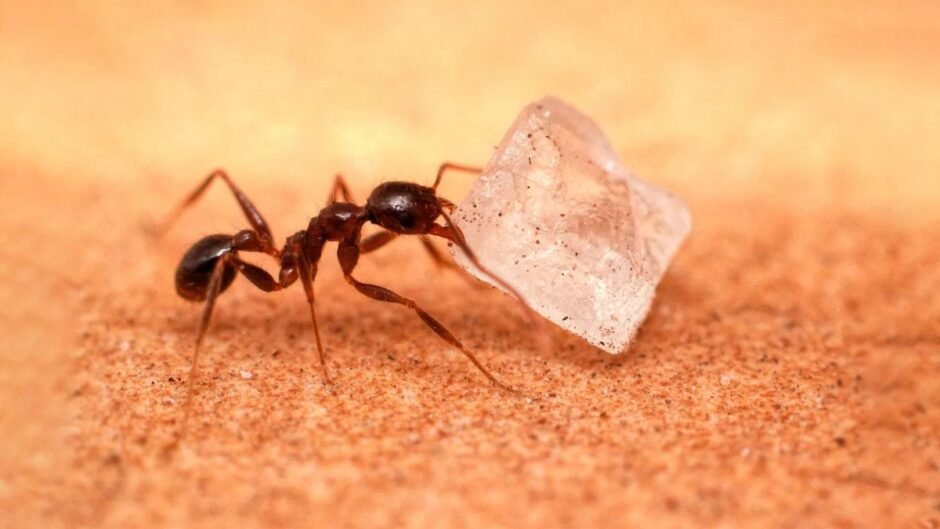
You set a mug on the counter and thirty tiny black ants swarmed it within an hour. They appeared from a crack in the backsplash you had never noticed before. Now there is a parade of them marching across the counter in a perfectly organized line, and every ant you kill is replaced by two more.
The ants you can see are about five percent of the colony. The other ninety-five percent are underground, in a wall void, or under the foundation slab. Killing the visible ants with spray does nothing. The colony sends replacements within hours. What you need is for the ants you can see to carry poison back to the nest and feed it to the queen. That is how you eliminate a kitchen ant problem permanently.
Here is how to identify what kind of ant you have, what bait to use, and how to make sure the colony dies rather than just relocating to the bathroom.
What Kind of Small Ant Is in Your Kitchen
If the ant is tiny, roughly an eighth of an inch long, dark brown to black, and gives off a rotten coconut smell when crushed, it is almost certainly the odorous house ant. This is the most common kitchen ant in the United States. They are called odorous house ants because of that distinctive smell, and they are small enough to enter through gaps in grout, caulk, and window frames that other pests cannot use.
If the ant is slightly larger, reddish brown, and bites when disturbed, it may be the pavement ant, which nests under concrete slabs and enters through foundation cracks. If the ant is very tiny, pale yellowish, and you see multiple trails rather than one distinct line, it may be the pharaoh ant, which is harder to eliminate because colonies split when threatened.
Identification matters because different species prefer different baits. Odorous house ants switch between sugar and protein depending on the season. Pavement ants prefer protein and grease. Pharaoh ants prefer protein and fat. If you put out sugar bait and they ignore it, switch to protein. If they ignore both, switch to a commercial bait that contains both sugar and protein in a gel matrix.
Do Not Spray the Trail
This is the single most common mistake people make with kitchen ants. You see a line of ants on the counter. You grab the insecticide spray. You kill every ant on the trail. You wipe the counter clean. The ants are gone.
For about six hours. Then they come back on a slightly different route.
Here is what actually happened. The spray killed the foraging workers but did not touch the colony. Worse, the colony detected the sudden disappearance of its foragers as a threat. In some species, particularly pharaoh ants and odorous house ants, this triggers a stress response called budding. The queen produces new reproductives and the colony splits into multiple smaller colonies that spread to new locations. A single trail on the kitchen counter becomes two trails, then three, then ants in the bathroom and the pantry.
Cleaning the trail with soap and water removes the pheromone path that ants follow. This disrupts the trail without killing ants and without triggering budding. Wipe the trail with warm soapy water or a vinegar solution. Then immediately place bait nearby on the same counter. The ants will find the bait, feed on it, and carry it back along a new trail. That new trail is the one you want. Do not wipe it. Let them build a highway directly from the nest to your bait.
Step One: Deploy the Right Bait
Ant bait is the only method that kills the colony. Ants are social insects. Workers forage for food and bring it back to feed the queen, the larvae, and the non-foraging workers. If the food contains a slow-acting poison, every ant that eats it dies, including the queen. Without the queen, the colony cannot produce new ants and collapses within days to weeks.
The poison must be slow. If ants die immediately after eating bait, they die on the way back to the nest and never deliver the poison. The ideal bait kills an ant 24 to 48 hours after ingestion. This gives the worker time to feed the queen and share the bait with other workers through trophallaxis, the mouth-to-mouth food exchange that ant colonies use to distribute nutrition.
Commercial Bait Stations and Gels
Pre-filled bait stations are the easiest option. Terro Liquid Ant Bait is the most widely available and uses borax as the active ingredient in a sugar solution. Place the bait station directly on the ant trail. Do not place it nearby. Place it on the trail so ants walk directly into it. Within hours, the trail will redirect through the bait station.
For ants that ignore Terro, try Advance 375A or Optigard Ant Gel. These contain different active ingredients and different food matrices. Advance uses a protein-based bait with abamectin. Optigard uses a sugar-based gel with thiamethoxam. If one bait is ignored, switch to a different food base and active ingredient combination.
DIY Borax Bait
Mix half a teaspoon of borax with half a cup of warm water and two tablespoons of sugar. Stir until the borax and sugar are fully dissolved. Soak a cotton ball in the solution and place it on the ant trail. The sugar attracts the ants. The borax kills them slowly.
The concentration matters. Too much borax kills ants before they reach the nest. Too little borax is ineffective. The half teaspoon to half cup ratio is a starting point. If ants are dying on the cotton ball within hours, dilute the mixture with more sugar water. If ants ignore it altogether, add more sugar.
For protein-feeding ants, substitute peanut butter for sugar. Mix a quarter teaspoon of borax into a tablespoon of peanut butter and place a small dab on a piece of wax paper on the ant trail. Protein baits spoil faster than sugar baits. Replace every two days.
Step Two: Track the Trail Back to the Entry Point
While the bait is working, follow the ant trail backward from the kitchen counter to its source. Ant trails typically enter through one of these locations: the gap where the counter meets the wall or backsplash, the opening around a pipe under the sink, a crack in the window frame or sill, the gap under an exterior door, or an electrical outlet on an exterior wall.
Do not seal the entry point yet. If you seal it before the colony is dead, the ants will find another exit, often in a different room. Let the trail function until bait has eliminated the colony. Sealing comes after you have gone three days without seeing any ant activity.
Step Three: Wait for Colony Collapse
After placing bait on the trail, expect to see more ants, not fewer, for the first 24 to 48 hours. This is the recruitment phase. Foragers that find the bait return to the nest and recruit more workers. The trail thickens. This is good. Every ant on the trail is collecting poison that will be fed to the queen.
By day three to five, activity should drop noticeably. The first ants to die are the larvae, which are fed directly by workers. Then the queen dies. Without the queen, no new workers are produced, and the existing workers die of old age over the next one to two weeks. Ant workers live about a month. Without replacements, the trail thins and eventually disappears.
If activity has not dropped by day seven, switch baits. The ants have either rejected the food base or the active ingredient concentration is wrong. Try a different commercial bait with a different food matrix and active ingredient.
Step Four: Seal the Entry Point After the Colony Is Dead
Once you have gone three days with zero ant activity, seal the entry point. Use silicone caulk for gaps around countertops, backsplashes, window frames, and pipe penetrations. For larger gaps under baseboards or where the floor meets the wall, use caulk or expanding foam, then cover with trim.
Outdoor entry points need weather-resistant sealing. Caulk around exterior door and window frames. Seal foundation cracks with hydraulic cement or polyurethane caulk. Check the exterior wall behind the kitchen. Ants often enter through the gap where the siding meets the foundation or where the AC refrigerant line enters the wall.
Step Five: Remove What Attracted Them in the First Place
Ants entered your kitchen because something was worth eating. Find it and eliminate it.
Wipe counters, stovetops, and tables with soap and water after every meal. A microscopic film of jam or syrup is a feast for a thousand ants. Pay attention to the toaster crumb tray, the blender base, the coffee maker drip tray, and the gap between the stove and counter. These are the spots people miss.
Store sugar, honey, syrup, and other sweeteners in sealed containers. The open bag of sugar in the pantry is a ant beacon. Transfer it to a sealed plastic or glass container. Do the same for pet food, which contains both protein and carbohydrates that ants forage for.
Take garbage and recycling out nightly. Rinse recyclables before putting them in the bin. An empty soda can in the recycling bin has enough sugar residue to support an ant trail. The garbage disposal may be grinding food, but the rubber splash guard harbors residue that ants feed on. Clean it weekly.
Check for moisture sources. Odorous house ants need water. A slow drip under the sink, condensation on pipes, or a damp sponge left on the counter all provide enough moisture to sustain foraging activity. Fix drips and keep surfaces dry.
Long-Term Kitchen Ant Prevention
Apply a perimeter barrier of food-grade diatomaceous earth along exterior door thresholds and window sills. This fine powder clings to ants as they cross it and abrades their exoskeleton, causing them to dehydrate. It is not a kill-on-contact method but a barrier that foraging ants learn to avoid after initial encounters.
Trim vegetation that touches the house. Tree branches, shrubs, and vines that contact exterior walls provide ant highways from the ground directly to your windows and roofline. Keep a gap of at least twelve inches between vegetation and the structure.
Inspect the kitchen monthly during spring and summer. Look for a single ant scouting on the counter. A lone ant is a scout looking for food. If it finds something and returns to the nest, a full trail follows within hours. Kill the scout immediately and wipe the area with soapy water to remove any pheromone trail it may have started laying on its way back.
Frequently Asked Questions
Why are there more ants after I put out bait?
This is the expected response and a sign the bait is working. Ants that find a rich food source return to the nest and recruit more workers to collect it. The trail thickens for 24 to 48 hours as the colony mobilizes to exploit what it perceives as an abundant food supply. Do not interfere. Every ant on the trail is carrying poison back to the queen. The number will drop sharply by day three to five as the poison takes effect.
Why does ant spray make the problem worse?
Ant spray kills foraging workers on contact but does not reach the colony. When large numbers of foragers suddenly stop returning, the colony detects a threat. In odorous house ants and pharaoh ants, this triggers budding, where the colony splits into multiple smaller colonies that spread to new locations. A single trail becomes multiple trails in different rooms. Additionally, spray residue repels ants away from that area, which pushes them to find new routes, often into rooms that previously had no ant activity.
Is borax bait safe to use in the kitchen?
Borax is low in acute toxicity to humans but should be treated as a chemical that does not belong in food. Place borax bait on wax paper or in a shallow dish, never directly on food preparation surfaces. Keep it out of reach of children and pets. The cotton ball method described above keeps the bait contained. Wash hands after handling borax solution. If you have crawling infants or pets that access countertops, use enclosed commercial bait stations instead of open DIY baits.
Why do ants keep coming back to the same spot after I clean?
Ants navigate by pheromone trails, not by memory. When a forager finds food, it lays a chemical trail on its way back to the nest. Other ants follow this trail to the food source and reinforce it on their return. Soap and water removes some but not all of the pheromone. Vinegar solution is more effective at breaking down the chemical trail. After cleaning, the residual scent can still attract occasional scouts for days. If ants return to the exact same spot repeatedly, the entry point behind that spot has not been sealed and the outdoor nest is still active. Bait the colony first, then seal the entry.
When should I call an exterminator for kitchen ants?
Call an exterminator if you have tried two different bait types over two weeks without a reduction in ant activity, if the ants are pharaoh ants which require professional-grade bait that is not available to consumers, or if the nest is in a wall void or under the slab where bait cannot reach the queen. Ant extermination typically costs $150 to $300 for a one-time treatment. Ongoing quarterly ant prevention runs $85 to $150 per visit.